Nail salons that use an autoclave: what it does and how to check
What an autoclave does to nail tools, why steam under pressure differs from wiping or soaking, what the pouch and indicator strip show, and how to check a kit.
Hygiene
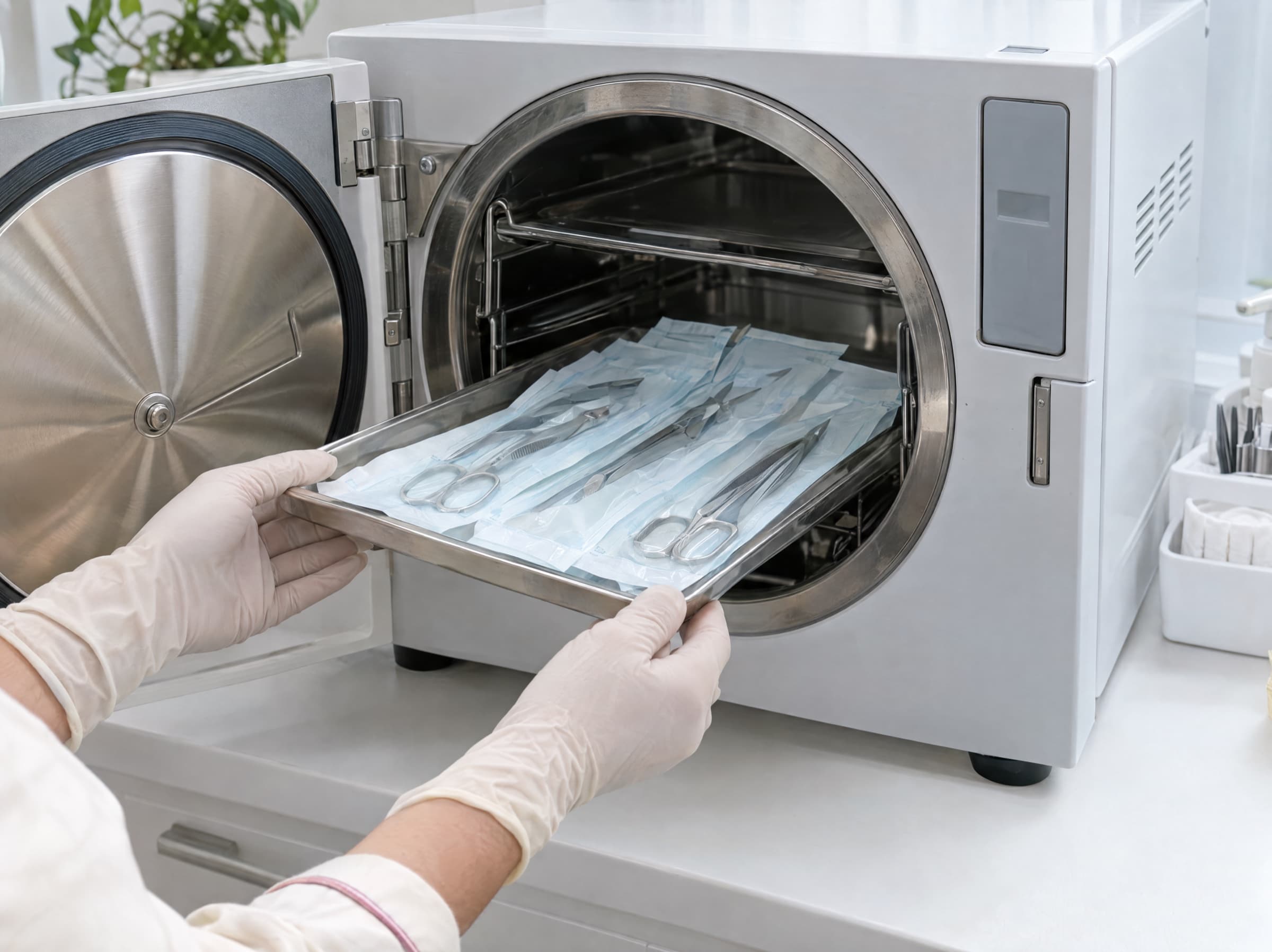
An autoclave is a pressure chamber that holds tools in steam at a set temperature for a set time, and it is the difference between tools that have been wiped and tools that have been sterilised. In a nail salon, or in the kit that comes to your home, the cuticle nippers, pushers and tweezers should go through one between clients. Here is what happens inside it, what the pouch and its indicator strip tell you, and how to check the kit coming to you.
Cleaning, disinfecting and sterilising are three different things
- Cleaning takes off what you can see: skin, dust, product, blood. It is the first step and nothing else works without it, because steam and chemicals cannot reach through dried residue.
- Disinfecting kills most of the microorganisms on a surface, but not all of them and not the hardiest forms, spores. That is what the jar of blue liquid on a salon counter does, and what an alcohol wipe does.
- Sterilising is meant to kill everything, including spores. For metal tools that is done with steam under pressure, in an autoclave. Tools that go near broken skin, and cuticle work breaks skin more often than anyone admits, need it.
A clean tool is not a sterile tool, and neither is a disinfected one.
What an autoclave does
Boiling alone does not reliably kill spores; raise the pressure and steam can be held at a higher temperature. The public guidance from the US Centers for Disease Control and Prevention puts it plainly: pressure is the means of reaching the temperatures needed to kill microorganisms quickly. The same guidance gives the ranges used in healthcare: wrapped items held for about 30 minutes at 121°C in a gravity-displacement steriliser, or about 4 minutes at 132°C in a pre-vacuum steriliser, with the exact time depending on the type of item, whether it is wrapped, and the machine. Tabletop autoclaves of the kind a nail kit uses run the same sort of cycle, with a drying phase so the pouches come out dry.
Two things follow. The tools must be clean before they go in, or the steam does not reach every surface. And the cycle must actually reach temperature and hold it; a door opened early or an overloaded chamber gives you warm tools, not sterile ones. That is why there are indicators.
The pouch
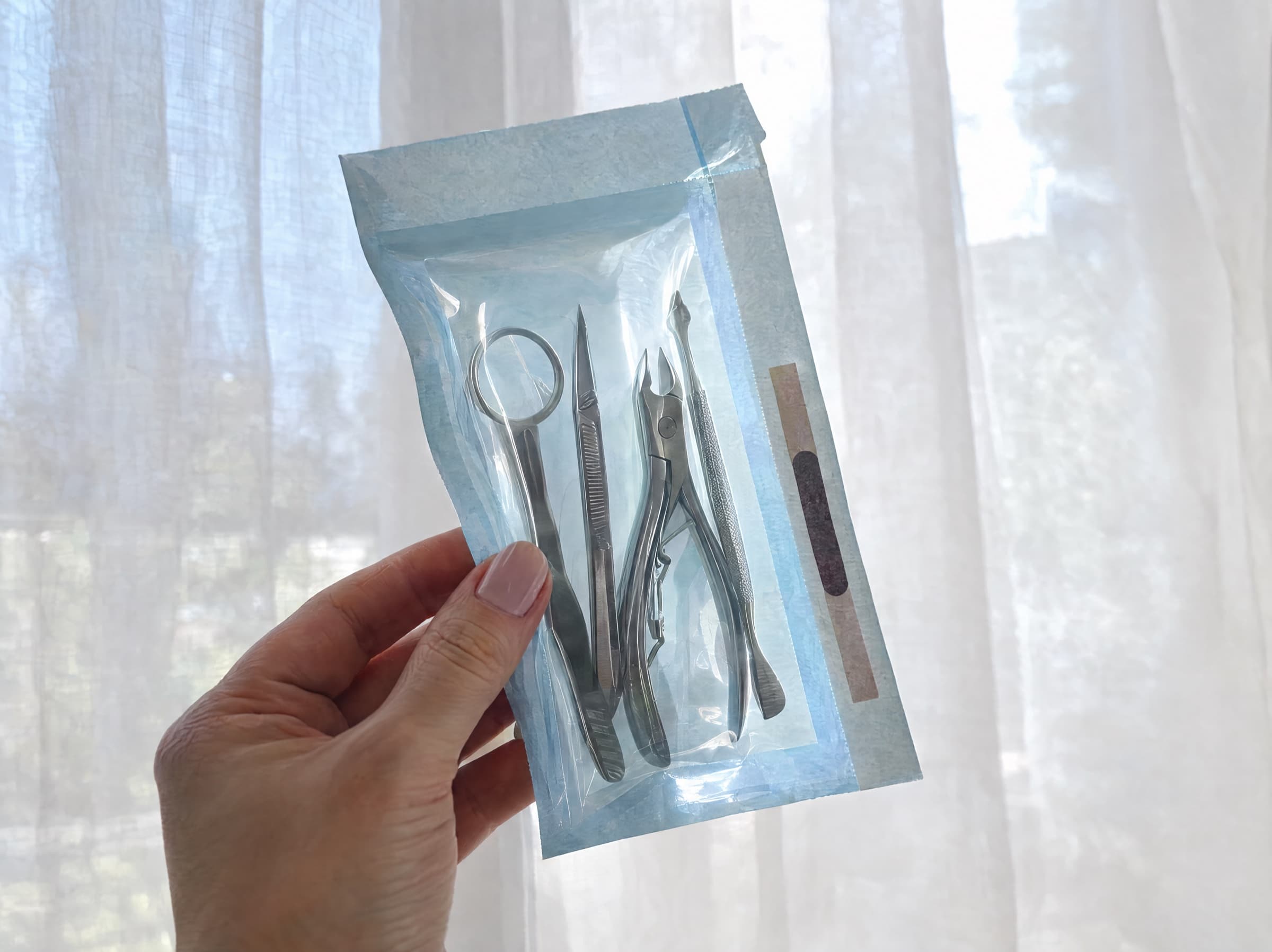
Tools are sealed in a sterilisation pouch before the cycle: paper on one side, clear film on the other. Steam passes through the paper, and once the pouch is sealed and dry nothing else does. That means the tools stay sterile inside it after the cycle, for as long as the pouch is intact, dry and closed. It also means the pouch should be opened in front of you, not earlier. A tool that arrives loose in a roll or a pocket may have been through an autoclave last week; there is no way to know what it has touched since.
The indicator strip
Every pouch carries a chemical indicator strip, printed on the outside or placed inside, that changes colour when it has been exposed to the temperature, or the time and temperature, of a steam cycle. It is the fastest check you can make: is the pouch sealed, and has the indicator changed?
Be clear about what it proves. A changed indicator tells you the pouch went through a cycle that reached the conditions the strip responds to. In healthcare, the definitive test of a steriliser is a biological indicator, a vial of resistant spores run through the machine and then cultured to see whether they survived; that is how a machine is proven, and it is a separate thing from the strip on your pouch. A changed strip and an intact pouch are the evidence a client can ask for; an unchanged strip, or no strip, is a reason to stop.
What a nail kit that uses an autoclave looks like
Ask about, or look for:
- Washing first. Tools are scrubbed and dried before pouching. Ask how.
- Pouches, sealed, with indicators. Every metal tool that touches you, in its own pouch or a small set, opened where you can see it.
- A cycle you can point to. After every client, or after every client day. "Regularly" is not an answer.
- A record. A machine that is used is a machine that is logged: date, time, cycle, result. A service that keeps one will be glad you asked.
- The porous things thrown away. Files, buffers, orange sticks and toe separators cannot be autoclaved, because they cannot be cleaned first. They are single-use: new for you, in the bin afterwards.
- The tub. A pedicure soak is warm water. A disposable liner, changed for every client, and a cleaned tub.
Can I go to the nail salon with nail fungus?
Better to see a doctor first and put the appointment off. A thickened, discoloured or crumbling nail may be a fungal infection, and it is a doctor's job to say so and treat it. A careful therapist will not file or polish an infected nail: filing spreads spores onto the tools, and polish over an infection hides it while it gets worse. If you are not sure what you are looking at, book a doctor before you book a pedicure. This is general information, not medical advice.
The same applies to cuts, warts, open blisters and any skin infection on the hands or feet. Tell us in the booking notes and tell the therapist before she starts.
What Hamd Beauty does
Every therapist carries a numbered kit, with an ID such as HB-K-001 printed on the case and shown in your booking. After every client day the kit's metal tools are washed, sealed in pouches and sterilised in an autoclave, and each cycle is logged against the kit with its date, time and indicator result. Files, buffers, wax spatulas, strips, mascara wands and similar items are used for one client only, opened in front of you and discarded when your visit ends. Your booking shows the kit ID and when it was last sterilised, and you can type any kit ID into the Hygiene Promise page to read its record. The questions to ask any provider, ours included, are in what to ask any home beauty service about hygiene.
What you can book
Every nail service on the nails page comes with the kit above: a classic manicure, a classic pedicure, or a gel manicure and gel pedicure. The pouch is opened at your table.
Quick answers
Sources
General information, not medical advice. If you have a health condition or are pregnant, ask your doctor first.