Arabic henna designs: Khaleeji and Emirati styles explained
Arabic henna designs in plain terms: what makes a Khaleeji design, what Emirati and Dubai-style henna mean, how they differ from mehndi, and how to ask for one.
Henna
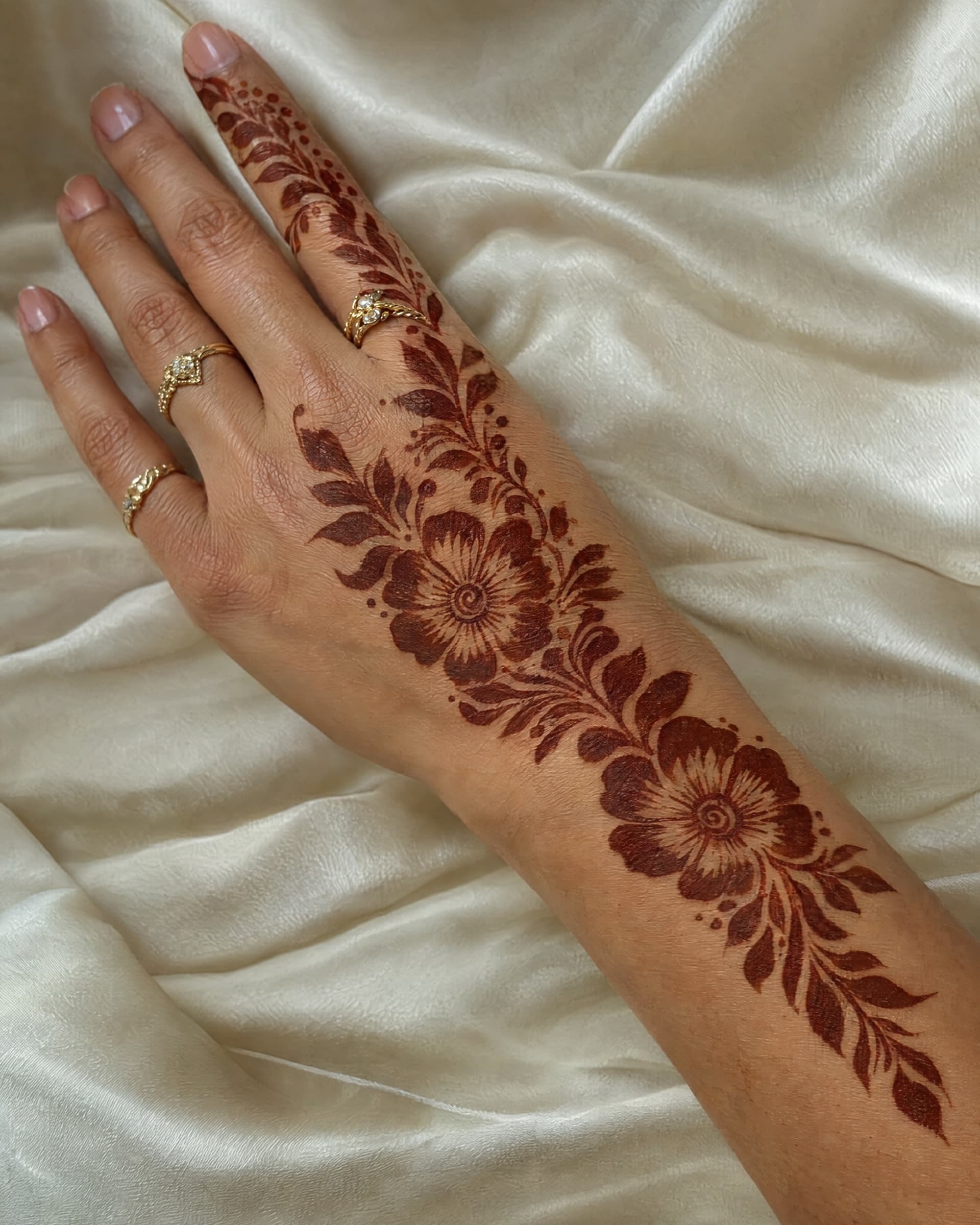
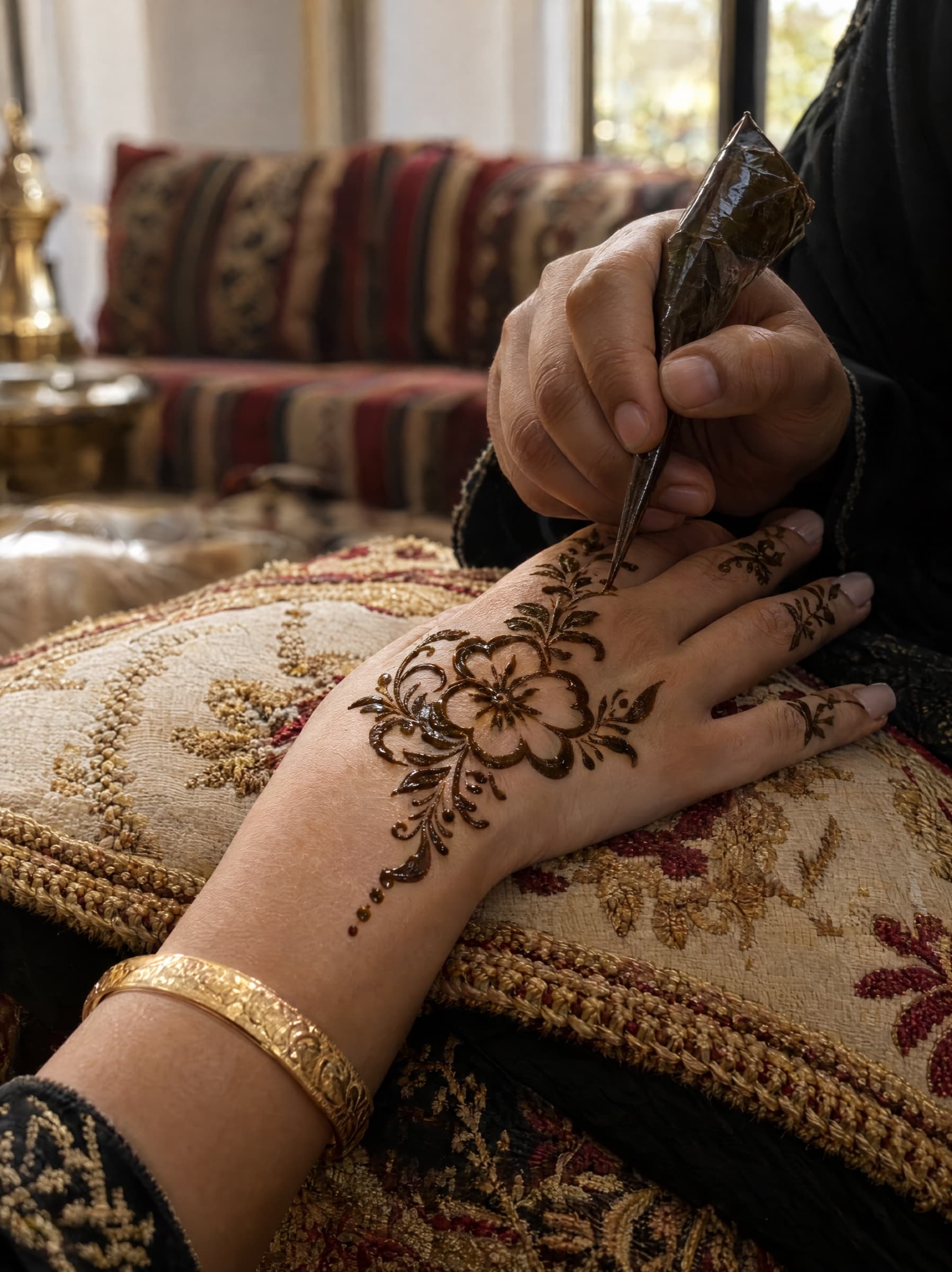
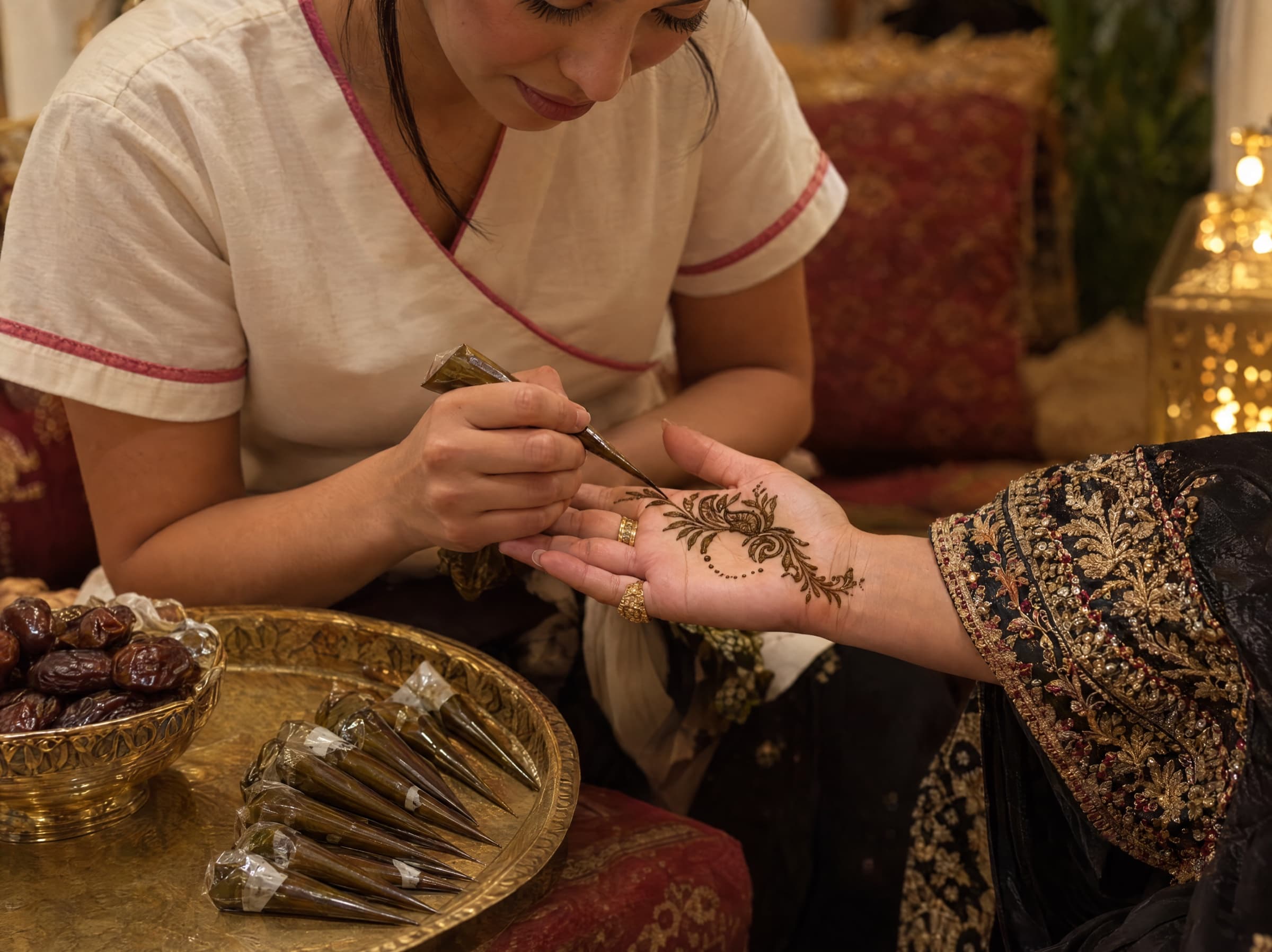
Arabic henna designs, and the Khaleeji style in particular, are built from a few large floral motifs on a flowing line, with bare skin left around them so the design reads from across a room. Indian mehndi goes the other way: fine, dense pattern that fills the hand. "Emirati" and "Dubai-style" henna are, in everyday use, ways of describing the Khaleeji look as it is worn here now. This article describes each so you can ask for what you want by name.
These are general descriptions of styles as they are widely understood. Every artist draws them her own way, and the names overlap.
What makes a design Khaleeji
Khaleeji henna is the Gulf style. Its features, as most people would describe them:
- Large, open flowers, usually roses or rose-like blooms, with broad petals and shaded centres
- Leaves and buds on a single vine that flows in one direction, often diagonally from a fingertip across the back of the hand and up the wrist
- Thicker, more confident lines than Indian work, with shading inside petals rather than fine filling
- Plenty of bare skin. The empty space is part of the design; a Khaleeji hand is never crowded
- Fingers either left bare, given one fingertip or ring, or capped with a solid band
- On the feet, the same vine wrapping from the toes over the top of the foot to the ankle
It photographs well and it suits a hand that will be seen from a distance, holding a coffee cup at a gathering or a bouquet at a wedding. Because there is less line to draw, it is also faster, which matters when a family of six is being done on the same evening.
Emirati and Dubai-style henna
When women search for Emirati henna or "henna design Dubai style" they usually mean the Khaleeji look as it is worn in the UAE: the same bold florals, in a cleaner and more spacious arrangement than a generation ago, and often with the fingertips filled in solid. "Traditional Emirati" in the sense of older, heavier designs is a term people use differently, and we would rather show you a photo than define it. If you have a picture of what your mother or grandmother wore, bring it; a good artist can work from it.
What you can safely ask for:
- Khaleeji, light: one vine, one side of the hand, fingers bare
- Khaleeji, medium: the vine plus a fingertip or ring, and a motif on the palm
- Khaleeji, full: both sides of the hand, up the forearm, fingertips solid
- Fingers only: rings and bands, nothing on the back of the hand
Floral henna
Floral henna overlaps with Khaleeji and is often the same thing. When it is used as a separate description, it tends to mean a softer, more naturalistic flower, sometimes with a single stem and leaves rather than a vine, and less shading. It is the style to name if you want something delicate rather than bold, and it suits a small design for a daytime gathering. On our menu, henna on both hands is offered as Khaleeji or floral for exactly this reason.
Indian and Pakistani mehndi, for comparison
Mehndi is the word used in South Asia for henna and for its designs. The bridal styles most people picture are the opposite of Khaleeji in almost every respect:
- Motifs: large flowers, leaves and vines in Khaleeji; paisleys, lattices, peacocks, tiny flowers and sometimes figures in Indian bridal mehndi.
- Line: thick and shaded; fine and dense.
- Coverage: one flowing trail with open skin; the whole hand and often the forearm, with little skin left bare.
- Time to apply: shorter; much longer.
- Reads best: from a distance; close up.
Pakistani bridal styles sit between the two, with Indian-style detail but more open sections and bolder outlines. Moroccan designs are different again: geometric, angular and symmetrical, drawn in straight lines and diamonds rather than curves. If you want one of these, say so; a Khaleeji artist and a mehndi artist are not always the same person.
Finger henna and light designs
"Henna on the fingers" is its own request and a popular one, especially for Eid and for women who want something for a week rather than a statement. It keeps the design to rings around the fingers, bands across the knuckles, dots, and small leaves, with the back of the hand bare. A light Khaleeji trail on one finger and down the side of the hand is the next step up. Both are quick to apply and easy to live with, and both fade tidily because there is no large filled area to go patchy.
Bridal henna in the Khaleeji style
A Khaleeji bride usually wears the full version: both hands front and back, the forearms to the elbow, and the feet to the ankle, with the fingertips filled. It is still recognisably Khaleeji, with open skin between the motifs, but there is more of it, and a bride who wants denser Indian-style coverage on the palms with a Khaleeji forearm can have that too. When to do henna before the wedding covers the timing.
How to ask for what you want
You do not need the vocabulary above; the therapist has it. What helps her is:
- The style: Khaleeji, floral, fingers only, Indian, or a photo.
- How heavy: light, medium or full.
- Where: one side of the hand or both, forearm or not, feet or not.
- Anything to avoid: nails, a ring you will not take off, a scar.
- Whether it needs to be dark by a certain day. How to get a darker henna stain explains what that takes.
Every therapist's profile on the therapists page shows her specialties and a gallery of her own work, so you can choose one whose hand you like before you book.
What you can book
Henna on both hands covers front and back in a Khaleeji or floral design, and bridal henna covers the hands to the elbow and the feet to the ankle. Both are on the henna page. For a family or a group of friends on the same evening, the group visit sends as many therapists as the group needs.